




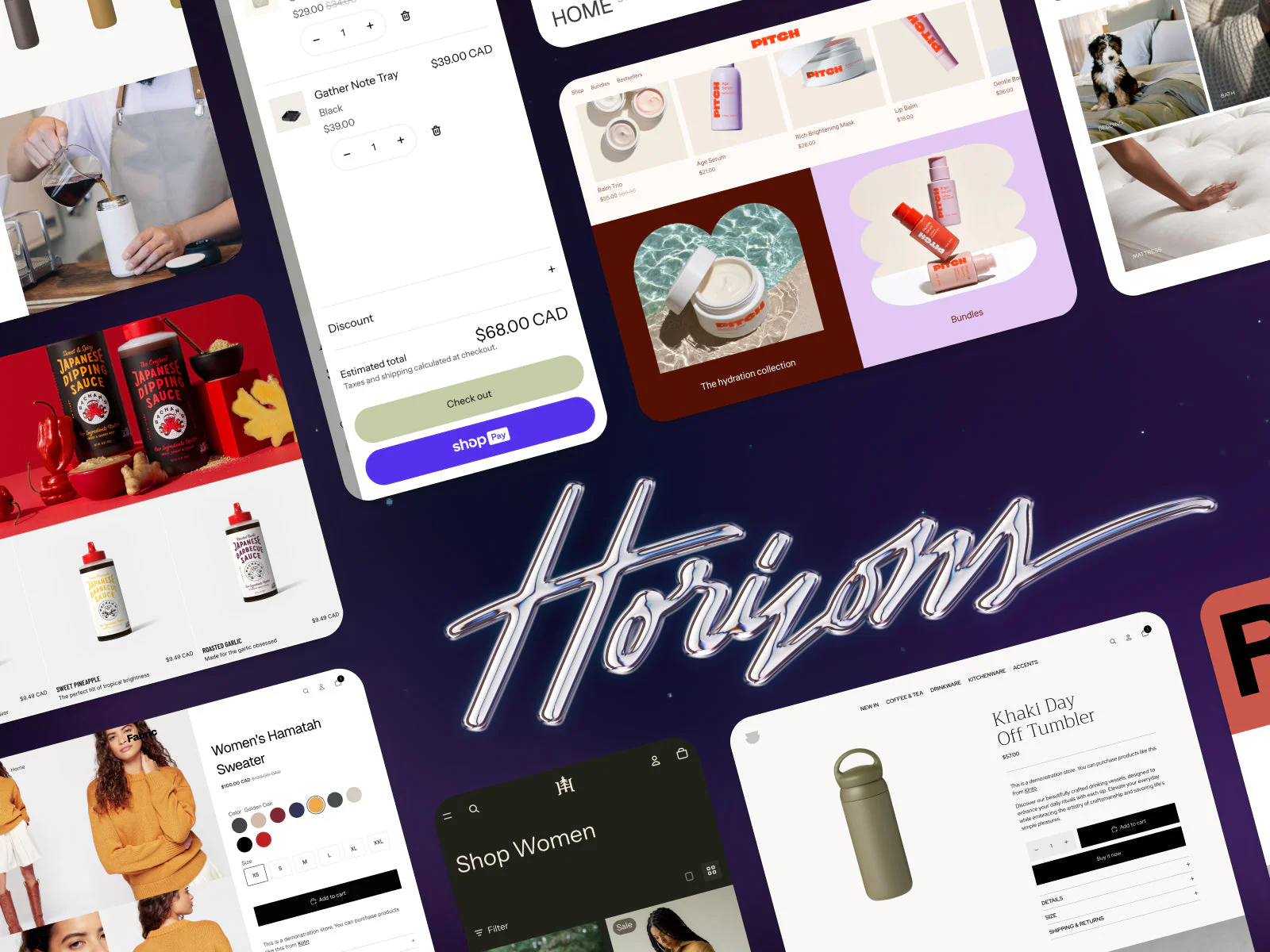
Why Shopify stores all look the same
There is a version of e-commerce that looks professional on paper and forgettable in practice. Most Shopify stores live there.
The template problem nobody talks about
Open any mid-sized Shopify store built in the last three years. There is a good chance you recognize the layout before you read a single word. The hero image with an overlaid headline, the four-column product grid, the sticky navigation bar, the announcement strip at the top. You have seen it before because you have seen it on fifty other stores.
This is not a coincidence. It is what happens when thousands of brands build on the same handful of themes. Dawn, the default Shopify theme, ships on a significant portion of new stores. Its variants and derivatives account for even more. The result is a market where competing brands are visually indistinguishable from one another.
The problem goes deeper than aesthetics. When your store looks like your competitor's store, the only differentiating factor left is price. That is a race nobody wins.
What headless commerce actually means
The phrase gets thrown around a lot, often without much clarity. Here is the simple version.
A traditional Shopify store is a single system. The backend, inventory, orders, payments, checkout, and the frontend, everything the customer sees and touches, are tightly coupled. Shopify controls both. You work within the constraints of what Shopify's themes and template language allow.
Headless commerce decouples those two layers. The backend stays on Shopify, which is where it belongs. Shopify is genuinely excellent at order management, payment processing, inventory, subscriptions, and the operational infrastructure of e-commerce. The frontend, however, is built separately, on any technology you choose, connected to Shopify via API.
The result is that Shopify handles everything it is good at, while the customer-facing experience is built without constraints.
The brands that already made this choice
This is not a niche experiment. Allbirds, Victoria Beckham Beauty, Rothy's, and McLaren F1 have all adopted headless Shopify architectures, each for the same core reason: they needed a frontend that matched the quality and specificity of their brand identity, and standard themes could not get them there.
For Victoria Beckham Beauty, the headless approach meant achieving an aesthetic that would have been impossible with a monolithic architecture, while also enabling international sales across multiple regions through a single Shopify backend.
For Allbirds, the headless build helped them achieve a clean, fast design with a strong personality, while ensuring a consistent experience across web, mobile, and in-store platforms. Two very different brands, same structural decision.
The numbers that actually mean something
The most credible data comes from brands that migrated to headless frontends and measured results against their own historical baselines.
Kaporal, a French denim brand, moved from a monolithic Magento setup to a headless architecture and tracked the results over nine months on a like-for-like basis. The bounce rate dropped by 60% across all devices. Conversion rates increased by 15% on desktop and 8% on mobile. Page views per session grew by 40% and time spent on site rose by 8%. These are not projections. They are before-and-after figures from the brand's own analytics.
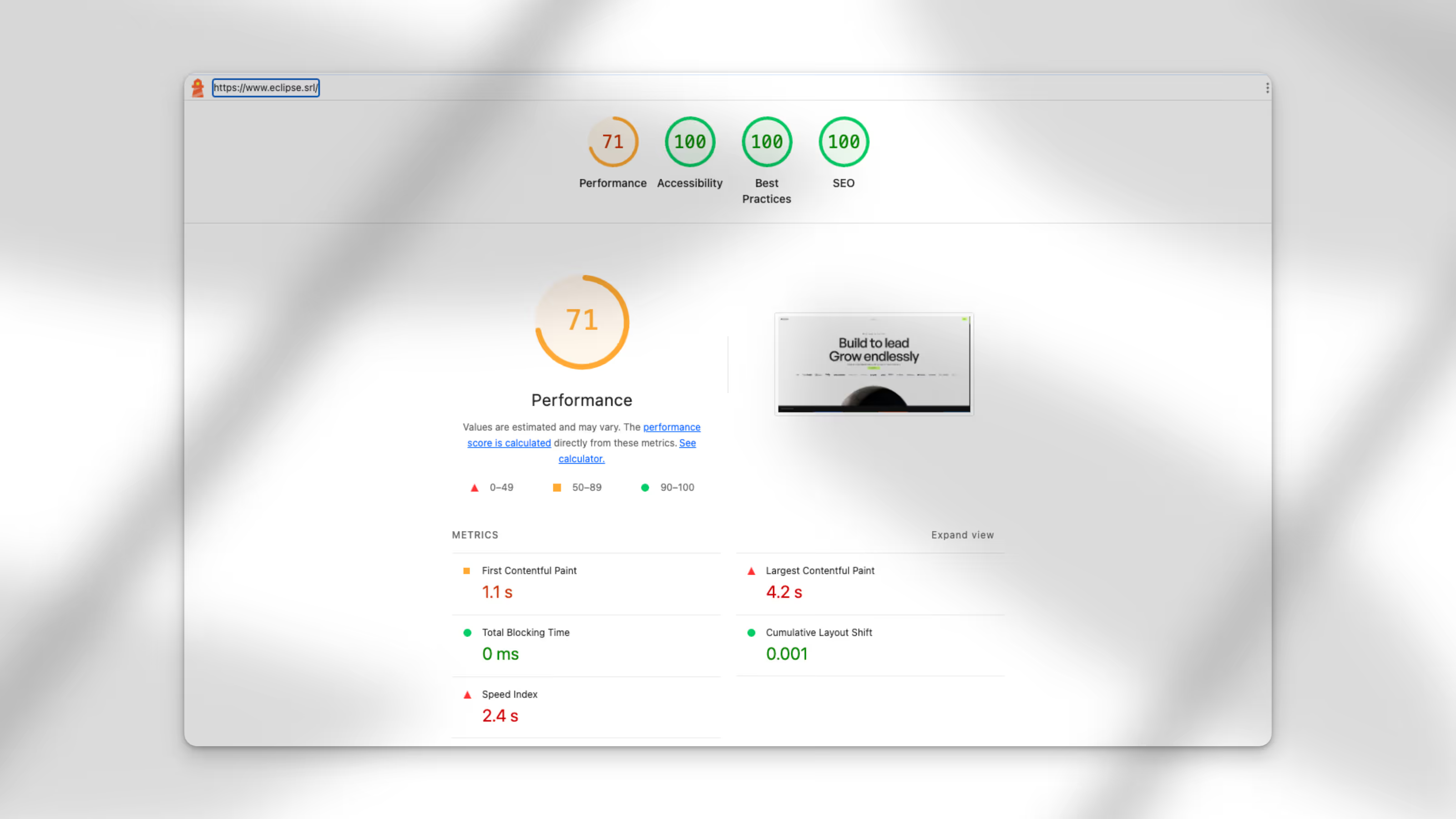
Devialet, the French audio equipment brand, doubled their mobile conversion rate within 16 weeks of launching their headless storefront. Their bounce rate dropped by 25% and their Lighthouse performance score moved from 70 to 95.
Both cases share the same pattern: a brand with a strong identity constrained by its platform, that unlocked measurable commercial results by separating design from the commerce backend.
The global headless commerce market is currently valued at $1.74 billion and is projected to reach $7.16 billion by 2032, growing at a compound annual rate of 22.4%. That growth rate outpaces general e-commerce expansion by a wide margin, which means the shift is not just following the market. It is running ahead of it.
Why this has historically been complicated
The argument against headless has always been cost and complexity. Building a custom frontend from scratch requires engineering resources, ongoing maintenance, and a level of technical coordination that most brands either cannot afford or cannot sustain.
That argument was valid for a long time. It is becoming less valid.
The barrier was never conceptual. Most brand teams understood perfectly well why a custom frontend was desirable. The barrier was execution: getting Shopify's backend to talk cleanly to a separately built frontend required custom API work, careful integration management, and a team capable of maintaining both sides of the architecture over time.
Where Webflow changes the equation
Webflow removes the most expensive part of that equation: building a custom frontend from scratch.
If you already work in Webflow, or work with a team that does, you have access to one of the most capable visual development environments available. Pixel-perfect layouts, advanced interactions, a structured CMS, full responsiveness, all without writing frontend code from the ground up.
The missing piece was always the connection to Shopify. That is exactly what we built Smootify to solve.
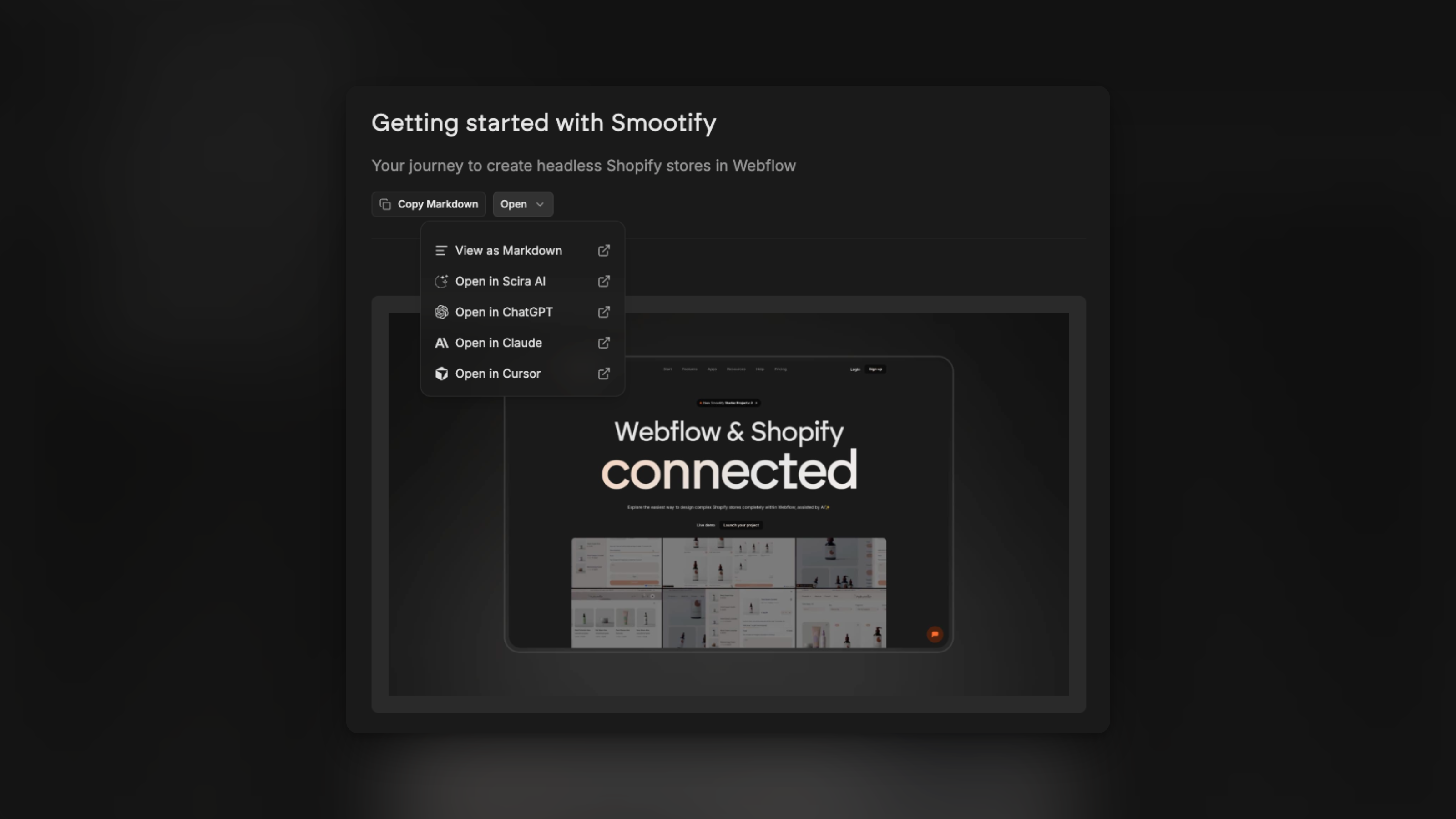
Smootify connects your Webflow project directly to your Shopify store. Products, collections, cart, and checkout all flow through Shopify's infrastructure. Everything the customer sees is designed and managed in Webflow. The sync between the two platforms is automatic: update a product in Shopify and it reflects in Webflow without any manual intervention.
The result is a genuinely headless setup built by the people who actually need to use it: designers and marketers, not just backend engineers. No fragile workarounds, no embedded widgets that break the visual consistency of the experience, no compromise between design quality and e-commerce reliability.
We built Smootify because we kept running into the same wall with our own clients. The tools that existed were either too brittle or too technical to maintain. We needed something that worked as a real product, maintained properly, and integrated deeply enough to feel native on both sides. That is what it has become.
The real cost of looking like everyone else
Every month a brand runs on a default Shopify theme is a month its visual identity is shared with thousands of other stores. That cost does not show up on a balance sheet. It shows up in conversion rates, in customer retention, in the perception gap between what a brand is and what its website communicates.
The technology to close that gap is available, it is significantly more accessible than it used to be, and the brands that have already moved are measurably ahead.
The question is not whether headless commerce is worth it. The question is how long you can afford to wait.
Learn more about Smootify and how it connects Webflow and Shopify.



.jpeg)
.avif)



.avif)